

This post may contain affiliate links and WPF may earn money or products from companies mentioned.
Every time we push back on people following Dave Ramsey, we get the same replies:
- You must be broke and you’re gonna stay that way.
- Most of the advice is fine, just ignore the stuff that isn’t.
- (Yes, you’re right, he sucks, there’s better people/Dave fucked me up)
So why won’t we shut up about him?
Transparency alert: Some links in this post are affiliate links, meaning WPF might earn a commission if you make a purchase—at no extra cost to you. Your support helps us keep empowering, educating, and supporting this amazing community.

Your money, your rules.
Monarch, rapidly becoming a community favorite, helps you track spending, plan your future and you can collaborate with a partner. All in one clean, ad-free space. Try it free, then get 50% off your first year of Monarch’s Core Plan.
Want to get these sent to your inbox every Tuesday?
Let’s do a little aside real quick → I started writing this on August 14th. By August 15th I started seeing Dave Ramsey trending on socials for saying socialists are parasites and encouraging someone not to leave her “socialist children” an inheritance. However, this isn’t a new statement or clip. It’s just really getting airtime suddenly. This podcast covered it on 8/16 if you want some more background. Meanwhile, our own Dave commentary went viral (hello if that’s how you found yourself here!)

So, if you’ve seen me eviscerating him on social media over the last week, today’s commentary might actually seem a little restrained. I had some specific points I wanted to cover here. Someone could write a whole book on why Dave Ramsey is a piece of shit though.
So why is Dave so bad?
Because the parts of “his” advice that are fine are not special. They are common knowledge.
The special flair and flavor that Dave adds? That stuff is SHIT. What makes Dave “Dave” is all the shame, lack of nuance, the Christian patriarchal leanings and fucked up relationships people develop with the concept of debt after falling under his influence.
Can you find some kernels of truth in what Dave preaches? Sometimes. But at what cost? How many new hang ups get introduced via his teachings? And once you get past debt, the, uh, sophistication (if there ever really was any) and utility of what he has to offer really falls apart.
Let’s talk about the debt snowball for example:
For sure, when you’re just starting out, the psychological motivation from being able to cross one item off your list can be compelling and help you to see that you can get something done. Any money educator can understand this concept and might tell you to do similarly.
But after that? The size of the debt isn’t the only thing that matters. The type of debt matters, The interest rates matter. Your cash flow mattes. Your goals and circumstances matter! Choosing which debts to focus on first can have a significant impact on how long it takes to pay off debt and how much it costs you along the way.
People need strong, sustainable habits, not temporary “money diets.” We all know extreme restriction can work for a period, but more often than not, results in the same situation, or worse, later.
Dave’s system, much like the churches where his teachings so often show up, encourages obedience to the mantras, not critical thinking. He’s not out there teaching people financial literacy, he is preaching a dogma. Rigid systems can be supportive at the very beginning – and this is why people do things like hire money coaches and financial advisors too (but those should come with a professional helping to assign a briefly rigid system that is still personal and unique to YOU).
The key to financial literacy is teaching people to think for themselves. It’s teaching them that there are options (like taking on debt at times!) and giving them the tools to help decide which options are better at some times than others.
The goal of financial education should be that you no longer need the educator, or their mantras.
The lack of nuance in these approaches also has real world consequences – declining to take a company match on your retirement accounts while you spend 5 years paying off debt? Let’s do some math on that.
Let’s use a 5% 401k match on a $70,000 salary. That’s about $3,500 from your company when you contribute $3,500 from your own earnings.
Let’s assume someone is 30 years old, and focusing on paying down student loan debt. Five years of savings at 7% return starting at age 30 could compound to roughly $170,000 by age 65. That’s nearly as much as the median retirement savings of Americans ages 55-64, and not far behind the median for those 65-74.
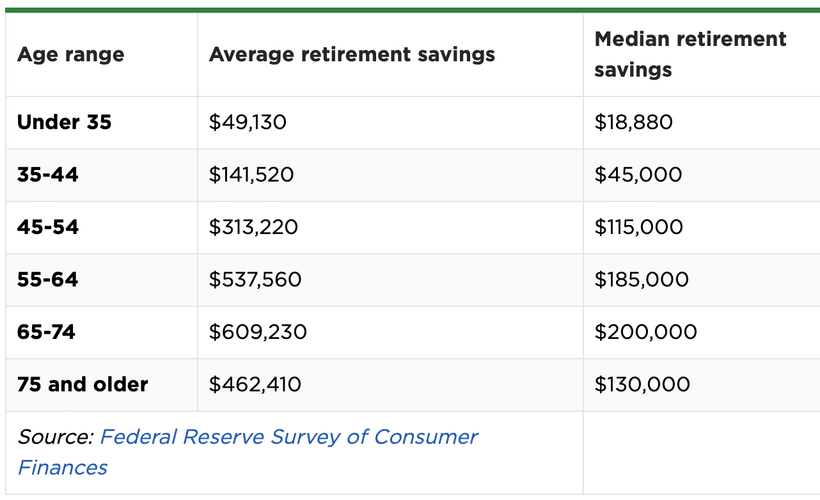
The employee? They only put $17,500 in from their own pocket and got another $17,500 from their employer as part of their compensation! That’s equivalent to $6.73 an hour, 10 hours a week for 5 years…
So, drive for DoorDash or take the match? Dave would have you delivering pizzas while declining part of your compensation package!! He’s literally telling people to give up money that’s already part of their compensation, then go work somewhere else to pay off debt faster.
This is just one example. There are so many more.
My personal interest here, aside from trying to alert others before Dave sets them back? Well, Dave was (unfortunately) my first true exposure to the world of personal finance. When I graduated from pharmacy school, someone gave me “The Total Money Makeover” as a graduation present. Luckily for me, I had already decided that living with the volume of consumer debt that most people take on was not what I wanted for myself. His book seemed pretty obvious for me and I quickly began looking deeper for what you’re supposed to do if you’re not mired in debt. His hook never worked on me.
And for those who do find themselves in that unfortunate position of large amounts of consumer debt, know there are other people out there talking about debt and debt pay off that doesn’t make you feel like a piece of shit for getting yourself there … or like you’re a failure because it’s taking immense effort to break out.
Shaming people for their debt becomes all the more monstrous when the basic costs of life are climbing far faster than people’s ability to pay for them. With a widening the gap, more debt is an unfortunate reality that many Americans are likely to face.
Even if you were able to grab those kernels of good (that any other financial influencer worth their salt could ALSO have taught you) while pushing past all the other distasteful elements, promise me two things:
- You won’t excuse his shit just because you didn’t step in the worst of it.
- You won’t waft his stench to someone new just because his pile is the biggest and easiest to find.
But, hey, you found us and you’re reading this. So, I suppose that’s all pretty unlikely, right?
PS. There’s no shortage of information on the internet. What’s harder to find is a place to talk through what actually makes sense for your life.
That’s a big part of what WPF Insiders is built around. Every other week we alternate between Investing Game Plan (for investing and portfolio discussions) and Closer to FI (for the life, priorities, and planning side of financial independence).
The goal isn’t for someone to tell you what to do. It’s having thoughtful people to help you think through your options. Add in our active Discord community, and you have a place to make financial decisions with community instead of in isolation.